Inventory carrying cost is the silent expense that most ecommerce brands underestimate by 30% or more. Every dollar sitting on a warehouse shelf is a dollar that isn’t funding your next product launch, paying for ads that drive revenue, or earning interest. It’s just sitting there, quietly draining your margin. For brands like PPTV, a growing ecommerce business, understanding the true cost of holding inventory is not an accounting exercise—it’s a direct driver of profitability and cash flow.
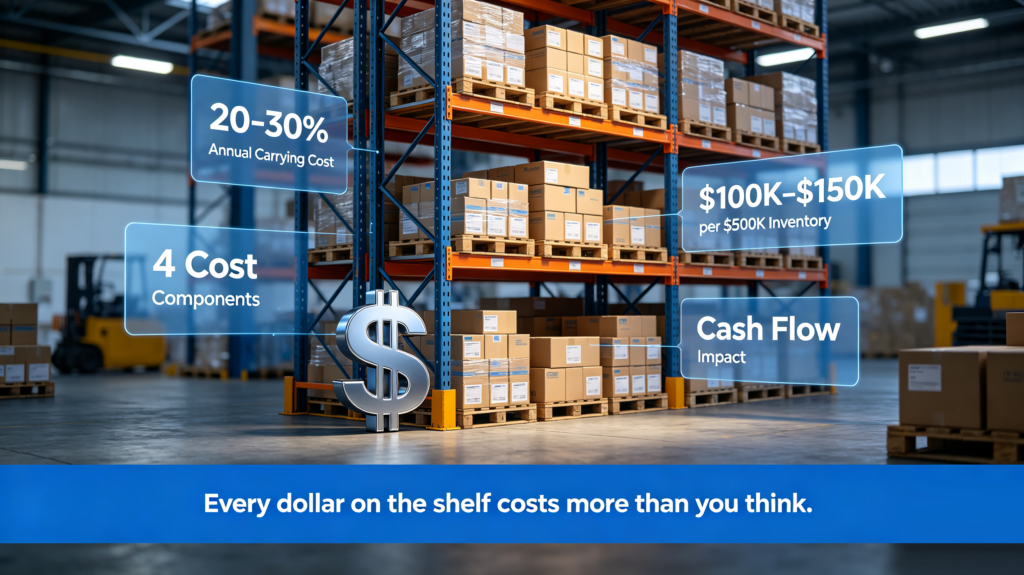
The standard benchmark across industries is that carrying costs run between 20% and 30% of total inventory value per year. That means if you’re holding $500,000 in inventory, you could be spending $100,000 to $150,000 annually just to keep it on the shelf. Not to buy it. Just to hold it.And ecommerce return rates now average 19–20.5%, with apparel and accessories routinely seeing 25–40% return rates, compounding the complexity of inventory management. This guide walks through exactly how to calculate your carrying cost, what components to include, and concrete strategies to bring that number down. And as always, Jetson is here to help brands like PPTV turn inventory efficiency into a competitive advantage—by providing real-time inventory visibility, optimized fulfillment networks, and data-driven solutions that keep carrying costs under control.
Step 1 : Identify the Four Components of Carrying Cost
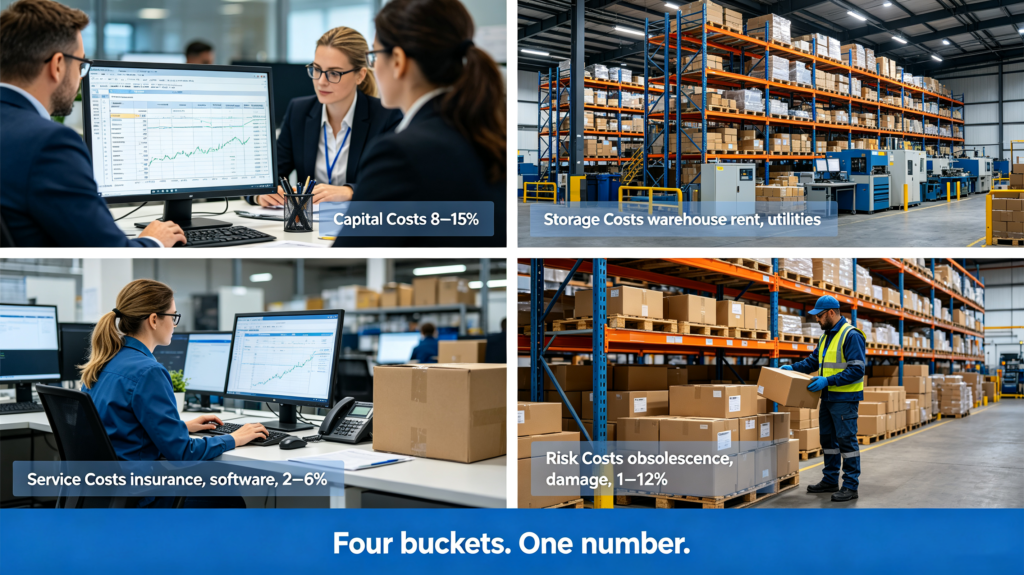
To calculate inventory carrying cost accurately, you need to account for four distinct cost categories. Most brands only track one or two of them, which leads to dramatically underestimated carrying costs. Understanding each component is the foundation for a reliable calculation.
Capital Costs
Capital costs represent the single largest component of carrying costs, typically accounting for 8% to 15% of inventory value on their own. This is the cost of the money tied up in your inventory—either the interest you pay on borrowed capital (7% to 15% annually depending on creditworthiness) or the opportunity cost of using your own cash. Even if you bought inventory with your own money, that capital had alternative uses: marketing, product development, or a simple high-yield savings account earning 4–5%. The return you’re forgoing is a real cost.
Advantages : The largest lever for reducing total carrying cost; directly tied to inventory levels.
Challenges : Most ecommerce brands completely ignore this component when estimating carrying costs.
Storage Costs
Storage costs are the direct, tangible expenses of physically housing your inventory: warehouse rent or mortgage payments, utilities (electricity, heating, cooling), and maintenance. If you store temperature-sensitive products, this number climbs fast. Whether you lease a 3PL or run your own facility, you’re paying for square footage—and that cost scales with how much inventory you hold.
Advantages : Tangible and trackable; directly reducible through smarter space utilization.
Challenges : Fixed costs make it difficult to reduce quickly without restructuring your warehouse footprint.
Service Costs
Service costs include everything required to “service” your inventory: insurance premiums, property taxes on stored goods, inventory management software licenses, cycle counting labor, and administrative overhead. These costs often hide in “overhead” on your P&L, making them invisible unless you specifically allocate them. Most firms allocate 2–6% of inventory value to this category.
Advantages : Often overlooked but real; can be optimized through better systems and processes.
Challenges : Hidden in overhead accounts; difficult to isolate without proper cost accounting.
Risk Costs
Risk costs capture losses and write-downs from obsolescence, expiry, damage, shrinkage, and pilferage. The right rate depends heavily on product life cycles and controls. Fast-fashion might carry 8–12% risk cost, while industrial fasteners might carry only 1–3%. For ecommerce brands with seasonal or trend-driven inventory, this component can be devastatingly high.
Advantages : Directly reducible through better demand forecasting and inventory turnover.
Challenges : Highly variable by product category; requires historical write-off data to estimate accurately.
Other Considerations
- Labor Costs : Wages for warehouse staff and time spent on inventory audits add to overall carrying costs.
- Technology Costs : Inventory management software incurs significant upfront and ongoing expenses, yet it is vital for tracking and optimizing stock.
- Turnover Impact : High turnover rates indicate faster sales, which lowers carrying costs. Low turnover signals overstocking or supply-demand mismatch, increasing carrying costs.
Step 2 : Apply the Carrying Cost Formula
With all four components identified, you can now calculate your carrying cost rate. The formula is straightforward, but the accuracy depends entirely on the inputs you use. For brands like PPTV, applying this formula correctly is the difference between guessing and knowing.
The Core Formula
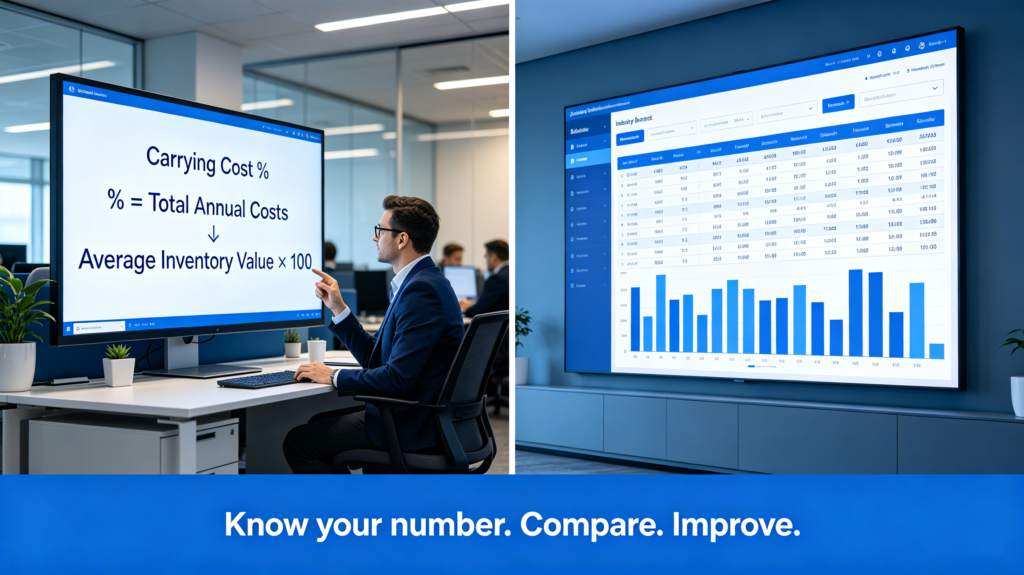
Carrying Cost (%) = (Total Annual Carrying Costs ÷ Total Average Inventory Value) × 100
Where:
- Total Annual Carrying Costs = Capital Costs + Storage Costs + Service Costs + Risk Costs
- Total Average Inventory Value = (Beginning Inventory Value + Ending Inventory Value) ÷ 2
The result is expressed as a percentage of your average inventory value. A rate of 25% means that for every $100,000 of inventory you hold, you’re spending $25,000 per year just to keep it on the shelf.
Worked Example
Here is a worked example for an ecommerce brand holding $100,000 of average inventory at cost:
| Component | Annual Cost | Basis |
|---|---|---|
| Capital Cost | $10,000 | 10% opportunity cost on cash tied up in stock |
| Storage (3PL fees) | $11,376 | 800 cu ft at metered rates |
| Service (insurance, software, handling) | $2,500 | Roughly 2.5% of inventory value |
| Risk (shrinkage, markdowns, obsolescence) | $5,000 | 5% of value |
| Total Carrying Cost | $28,876 | 28.9% of average inventory value per year |
Two things stand out. First, the total lands near the top of the 20–30% consensus range, not the midpoint. Second, capital cost is the largest line for most non-FBA brands, and it scales with how you fund inventory.
Pro Tip : Use average inventory value at cost, not retail. Use your COGS records, including freight and duties, and average the inventory balance across the year rather than taking a single point-in-time snapshot. A year-end count taken right after Q4 sell-through will flatter the ratio badly.
Industry Benchmarks
Once you have your carrying cost rate, compare it against industry benchmarks to assess your performance:
| Industry | Typical Carrying Cost Range |
|---|---|
| Grocery / Perishables | 25–35% |
| Consumer Electronics | 20–30% |
| Apparel / Fashion | 20–35% |
| Industrial / B2B Distribution | 15–25% |
| Pharmaceuticals | 20–30% |
Ecommerce businesses typically land in the 18–30% range, while wholesale operations may see 25–40%.If your number is significantly higher than the benchmark for your category, there’s likely room for improvement. If it’s significantly lower, you may be missing cost components.
For PPTV, Jetson provides real-time inventory cost tracking and benchmarking tools—including automated carrying cost calculations, per-SKU cost allocation, and dashboard reporting that turns raw inventory data into actionable insights.
Step 3 : Reduce Carrying Costs Without Sacrificing Service
Calculating your carrying cost is only the first step. The real value comes from reducing it—without hurting your ability to serve customers. Reducing carrying cost from 28% to 24% on $5 million of average inventory frees $200,000 annually. That capital can fund growth, automation, or simply reduce financing expense—directly improving margins without selling an extra unit.Here are the key strategies for brands like PPTV:
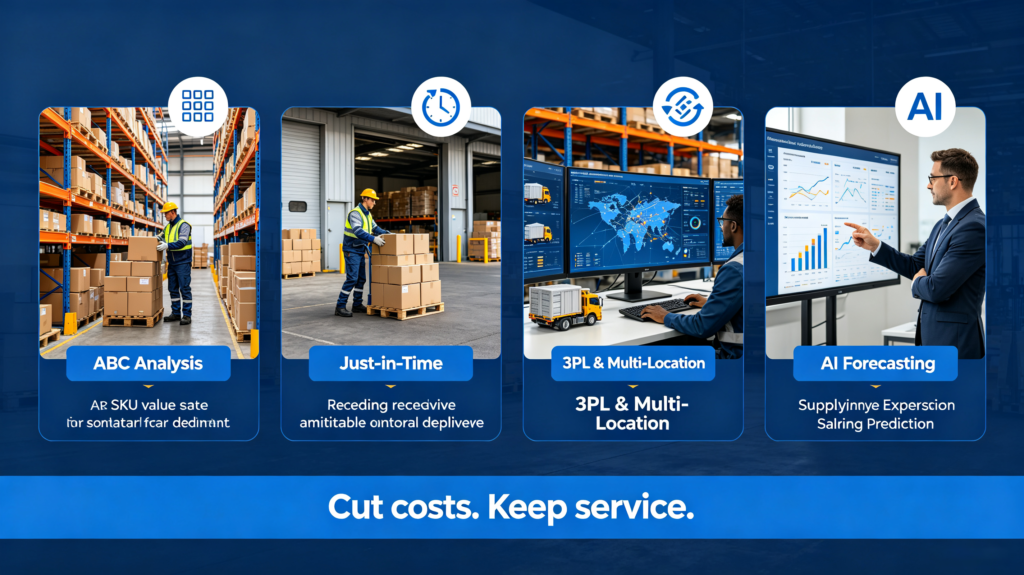
Optimize Inventory Levels with ABC Analysis
Not all SKUs deserve the same inventory investment. ABC analysis segments your inventory by value and velocity: A-items (high value, high turnover) should be kept lean and restocked frequently; C-items (low value, slow moving) can be stocked more deeply to reduce ordering costs. Inventory segmentation guides practical strategies for reducing carrying costs on slow-moving items while maintaining service levels on top sellers.
Implement Just-in-Time Replenishment
Just-in-Time (JIT) inventory management orders stock only when needed, dramatically reducing the capital tied up in inventory. This approach works best when suppliers are reliable and lead times are short. For ecommerce brands, JIT can be combined with safety stock buffers for high-demand SKUs to balance risk and efficiency. Smaller, more frequent buying cycles can reduce the cash flow strain of large seasonal orders.
Leverage 3PL and Multi-Location Fulfillment
Where you store inventory directly impacts storage costs, transit times, and risk exposure. A multi-distribution warehouse network positions inventory closer to customers, reducing transit times and lowering last-mile costs. Using a domestic 3PL as a staging buffer before sending inventory to marketplace fulfillment centers can reduce aged inventory penalties and improve turnover. Spreading inventory across more locations, however, increases total carrying cost through duplicated storage and management overhead—so the goal is optimization, not maximization.
For PPTV, Jetson provides multi-location fulfillment solutions—including strategic warehouse placement, inventory rebalancing across locations, and optimized routing that reduces transit times while keeping carrying costs in check.
Use AI for Demand Forecasting
Demand forecasting is the single most powerful lever for reducing carrying costs. AI-driven forecasting tools analyze sales data, seasonality, and market trends to predict demand with far greater accuracy than manual methods. MIT and Mecalux have developed AI-based simulators that optimize inventory distribution across warehouses, reducing costs and improving logistics efficiency. These systems enable real-time tactical planning by analyzing thousands of scenarios in minutes.
Step 4 : Monitor, Report, and Continuously Improve
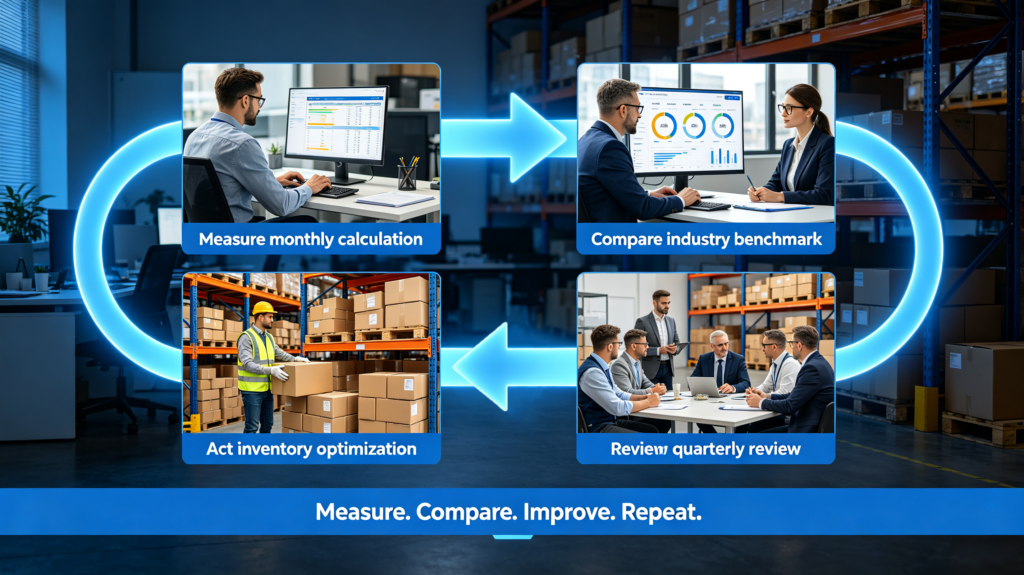
Carrying cost is not a one-time calculation—it’s a metric that should be tracked monthly and reviewed quarterly. Without continuous monitoring, costs creep back up as inventory levels drift and market conditions change. For brands like PPTV, building a culture of inventory cost awareness is the final pillar of long-term efficiency.
Set Up Monthly Tracking
Calculate your carrying cost rate every month, not just once a year. Monthly tracking reveals trends that annual calculations miss—seasonal spikes, slow-moving SKU accumulation, and the impact of promotional periods. Compare your rate against your industry benchmark and set improvement targets. A reduction of even 2 percentage points compounds significantly across a full year’s inventory value.
Close the Loop with Finance and Operations
Carrying cost is a bridge metric between finance and operations. Finance teams focus on cash flow and return on assets; operations teams focus on service levels and inventory availability. When both teams share a common carrying cost metric, decisions become aligned: operations understands the financial cost of holding extra stock, and finance understands the service risk of cutting inventory too aggressively.
Pro Tip : Share carrying cost data in weekly operations meetings and monthly financial reviews to maintain visibility and accountability across both teams.
Build a Continuous Improvement Cycle
Treat carrying cost reduction as an ongoing program, not a one-time project. Set quarterly targets, review SKU-level performance, and adjust replenishment parameters as market conditions evolve. Companies that deploy AI-driven inventory optimization report significant reductions—Fujitsu subsidiary FSAS Technologies achieved a 20% reduction in excess inventory and a 50% reduction in inventory orders within six months of implementing process intelligence across its supply chain.
Calculating Inventory Carrying Cost? Jetson Has Solutions for You
Calculating and reducing inventory carrying cost is one of the highest-leverage financial moves an ecommerce brand can make. By identifying all four cost components, applying the formula correctly, implementing proven reduction strategies, and monitoring continuously, brands like PPTV can free up working capital, improve margins, and build a more resilient supply chain.
For brands like PPTV, success in inventory cost management requires the right partner to handle the operational complexity. Jetson provides end-to-end fulfillment solutions designed specifically for inventory efficiency—from real-time cost tracking and multi-location inventory optimization to AI-driven demand forecasting and automated replenishment. With Jetson, PPTV can focus on growing the business while we ensure every dollar of inventory works harder.
Choose Jetson to transform your inventory operation from a cost center into a competitive advantage. Contact us today to learn how we can help you calculate, reduce, and control your inventory carrying costs with confidence.