Storing FDA-regulated products is not like storing ordinary consumer goods. A warehouse that holds food, dietary supplements, cosmetics, or medical devices operates under a regulatory framework that touches every aspect of its design, documentation, and daily operations. The FDA does not issue “approvals” in the way most people imagine—there is no certificate you hang on the wall. What exists is a registration system, a set of enforceable requirements, and an inspection regime that determines whether a facility can legally hold regulated products for U.S. distribution. For brands like Aur, a growing ecommerce business in the regulated product space, understanding this distinction is the difference between a compliant supply chain and a shipment held at the border.
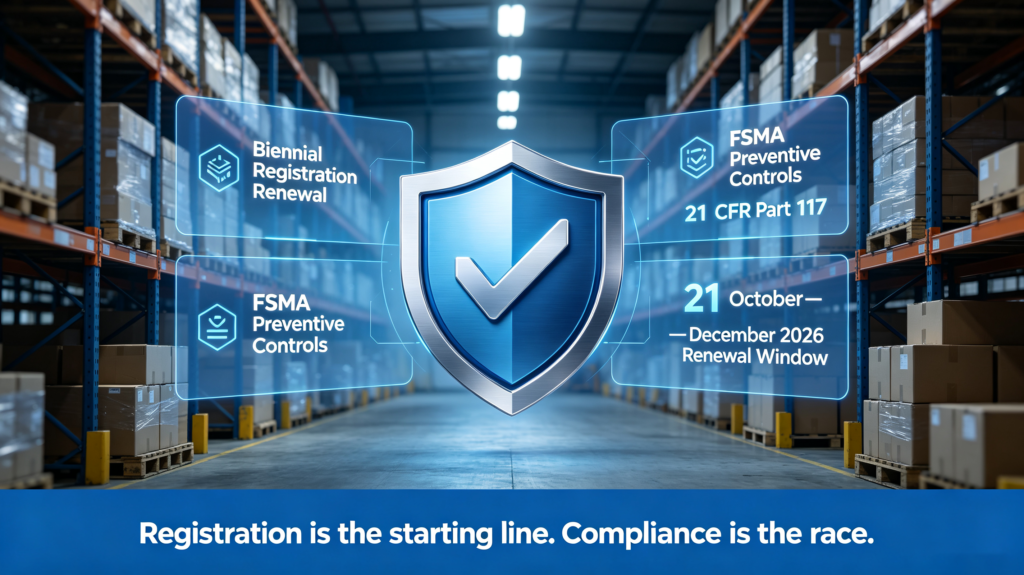
The FDA‘s food facility registration is mandatory for any domestic or foreign facility that manufactures, processes, packs, or holds food for U.S. consumption. Holding food counts—a warehouse storing your product is in scope. The registration must be renewed every two years during the October 1 to December 31 window of even-numbered years, and a lapsed registration means product from an unregistered facility can be refused at the border or held. This guide walks through what it actually takes to become an FDA-compliant warehouse, from registration and facility design to FSMA preventive controls and inspection readiness. And as always, Jetson is here to help brands like Aur navigate regulated fulfillment—by providing FDA-registered warehousing, temperature-controlled storage, lot-level traceability, and compliance documentation that keeps products moving and regulators satisfied.
Step 1 : Register Your Facility with the FDA
FDA facility registration is the foundation of every compliant warehouse operation. Without it, a facility cannot legally hold FDA-regulated products for U.S. consumption, and any inventory stored there risks being refused at the border or seized during an inspection. For brands like Aur, confirming that a warehouse partner holds an active registration is the first question to ask before signing any contract.
Who Must Register
Under 21 CFR 1.226, domestic and foreign facilities that manufacture, process, pack, or hold food for human or animal consumption in the United States must register with the FDA unless an exemption applies. “Holding” includes warehousing, cold storage, distribution centers, and bonded storage sites. A third-party warehouse used exclusively for storing finished products is still a food holding facility and must register. Exemptions exist for facilities that only transport food, cross-dock without storage, or operate as retail food establishments—but these are narrow and do not apply to most 3PL warehouses.
Advantages : Registration is free, establishes legal eligibility to hold regulated products, and is required for any downstream partner relationship.
Challenges : The registration must be renewed biennially; a lapsed registration is treated as expired and creates immediate compliance exposure.
What Information Is Required
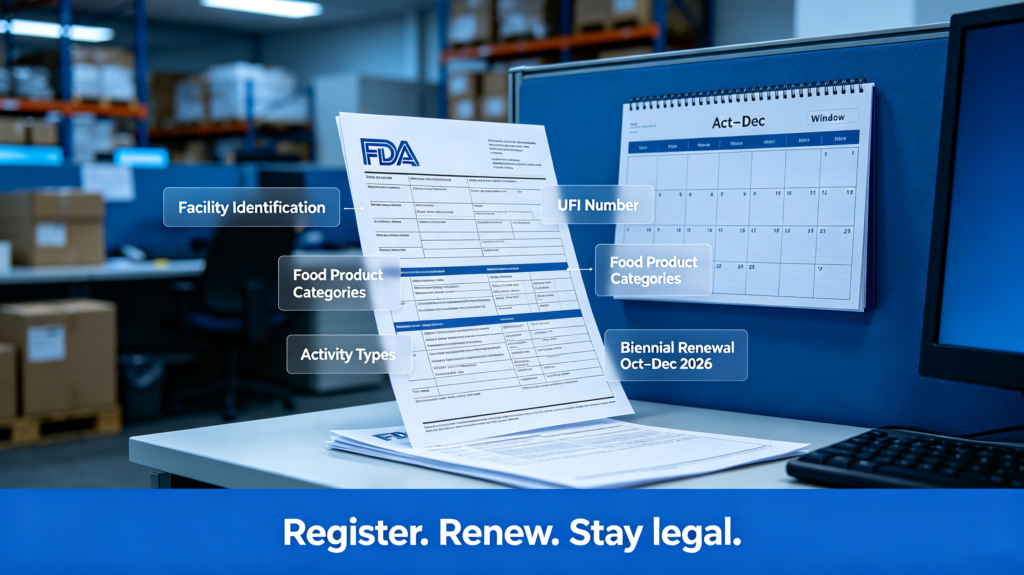
The registration submission must include the facility‘s name, full address, and phone number; a Unique Facility Identifier recognized as acceptable by FDA; all trade names the facility uses; the name, address, phone number, and email address of the owner, operator, or agent in charge; the applicable food product categories stored at the facility as identified on Form FDA 3537; and the type of activity conducted for each category. Activity types for storage facilities include ambient human food warehouse, refrigerated human food warehouse, frozen human food warehouse, and animal food warehouse. The registration must also include a statement assuring that FDA will be permitted to inspect the facility at the times and in the manner permitted by the Federal Food, Drug, and Cosmetic Act.
Pro Tip : Confirm the facility’s registration status before committing inventory. Ask for the registration confirmation document, not just a verbal assurance. A badge in a website footer tells you nothing about whether that warehouse can produce a registration certificate on request.
Biennial Renewal Window
Food facility registrations must be renewed every two years during the October 1 through December 31 window of even-numbered years. The 2026 renewal window runs October 1 to December 31, 2026. There is no FDA fee for registration or renewal, so a lapsed registration reflects a process failure, not a budget one. Product from an unregistered facility can be refused at the border or held, and operating an unregistered facility that stores food is a prohibited act.
Example : A brand evaluating a new 3PL in Q3 2026 should confirm that the facility‘s registration is current and that the renewal is scheduled before the December 31 deadline. A registration that lapses on December 31 is treated as expired on January 1.
Step 2 : Build a Facility That Meets FDA Design and Storage Requirements
Registration establishes the facility on the FDA’s radar. The compliance work is separate and ongoing. Facility design, storage conditions, and segregation practices determine whether a warehouse can actually maintain product integrity and pass an inspection. For brands like Aur, the physical capabilities of a warehouse partner are as important as its registration status.
Defined Storage Zones and Segregation
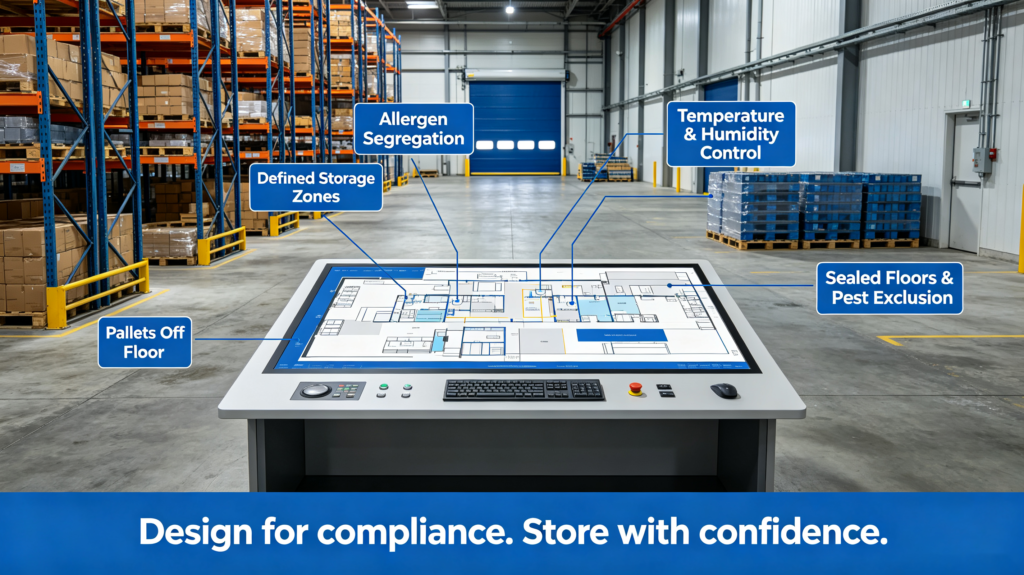
FDA guidelines require warehouses to have well-defined areas for the storage of different product types. Defined zones mitigate cross-contamination risks, especially when storing allergens, medications, or products with different handling requirements. High-risk products should be stored away from lower-risk items, and the layout should ensure that allergen-containing products cannot contaminate others through physical separation. Chemical segregation is equally important: cleaning chemicals and non-food goods must be stored well away from food products.
Advantages : Zoning reduces cross-contamination risk, simplifies inventory tracking, and supports recall management.
Challenges : Requires sufficient square footage and deliberate layout planning; retrofitting an existing facility can be costly.
Temperature and Humidity Control
Many food and drug products require specific storage conditions that must be consistently maintained to preserve quality. Pharmaceuticals often require cool and dry environments. Shelf-stable food typically requires 50°F to 70°F storage with relative humidity below 60%. Monitoring systems should track temperature and humidity levels continuously, with alarms set to alert staff of deviations from established parameters. Documented evidence of environmental conditions may be required during inspections, so monitoring logs are not optional.
Pro Tip : Ask for temperature and humidity logs from the last 30 days. A facility that cannot produce continuous monitoring data is not ready for regulated products.
Physical Infrastructure Requirements
The physical condition of the facility matters as much as its operational procedures. Pallets should be stored off the floor and away from walls, with a defined perimeter aisle so inspection and cleaning can happen behind racking. Floors must be sealed, with no exposed wood or flaking paint—chipping surfaces above stored product are a physical-hazard finding. Dock and door integrity is critical: sealed doors, air curtains or rapid-close doors, and screened openings keep pests out. These are not cosmetic preferences; they are inspection criteria.
For Aur, Jetson operates FDA-registered warehousing with temperature-controlled zones, sealed flooring, pest-exclusion infrastructure, and continuous environmental monitoring. Every facility is designed to meet 21 CFR Part 117 storage requirements from the ground up, not retrofitted.
Step 3 : Implement FSMA Preventive Controls and Documentation
The Food Safety Modernization Act shifted the regulatory posture from responding to contamination to preventing it. For a storage facility, that translates into a written food safety plan, hazard analysis appropriate to what is stored, monitoring procedures, corrective actions, and verification records. The FDA‘s approach to inspections is system-based, not just a physical walk-through. Investigators review the paper trail as closely as they inspect the floor. For brands like Aur, the documentation that a warehouse partner can produce on demand is the real measure of compliance.
Written Food Safety Plan and Hazard Analysis
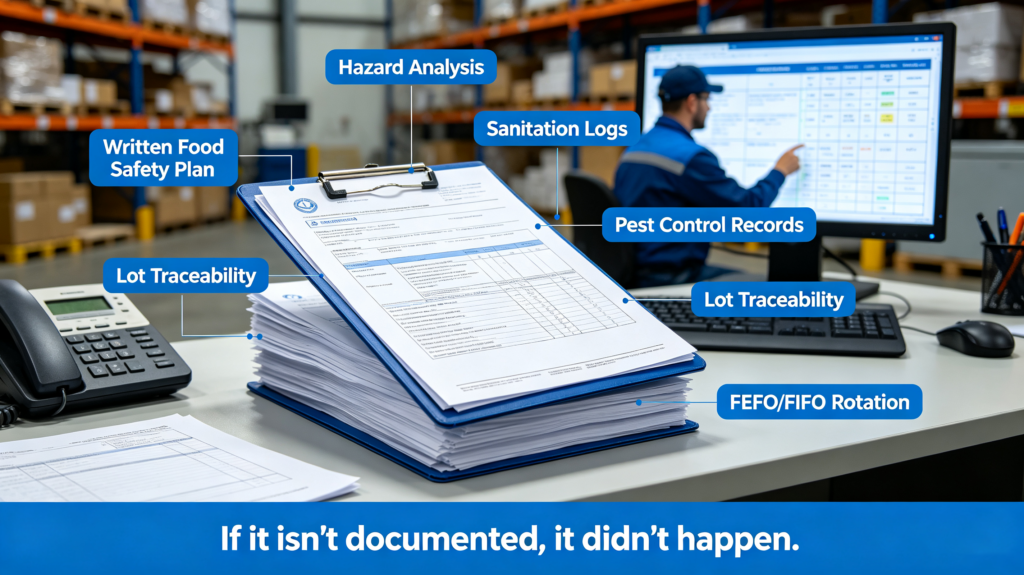
A compliant warehouse must maintain a written food safety plan that includes a hazard analysis specific to the products stored, preventive controls for identified hazards, monitoring procedures, corrective action protocols, and verification records. The plan must be site-specific—a generic template that does not reflect the actual products and conditions of the facility will not hold up during an inspection. Ask to see the plan, not just hear that one exists.
Key implication : The hazard analysis should identify biological, chemical, and physical hazards relevant to the stored products, including allergen cross-contact risks and temperature abuse scenarios.
Sanitation and Pest Control Records
Scheduled cleaning with logs, a contracted pest control program with service reports and trap maps, and defined corrective actions when something is found—these are the records that demonstrate a functioning sanitation program. A clean-looking building with no documentation is not auditable. Pest control service records for the last 12 months should be available on request, along with sanitation logs that show actual dates, times, and responsible personnel.
Worked example : During an inspection, the FDA investigator opens with an interview, then walks the facility from product receipt through storage and distribution. What trips up facilities most often is not the physical space—it is the paper trail. Receiving logs, cleaning schedules, pest control records, temperature monitoring data, and employee training documentation are the items most frequently found missing or incomplete.
Lot Tracking and Traceability Systems
GMP requirements under 21 CFR Part 117 mandate that inventory be tracked by batch or lot number, and that warehouses follow FEFO (First Expired, First Out) or FIFO protocols. In the event of a recall, the warehouse must be able to produce a traceability list that identifies which customers received product from a specific lot, and when. A warehouse that cannot produce a recall list in ten minutes is not a compliant partner for regulated products.
Pro Tip : Run a mock recall with your top two warehouse candidates before signing a contract. Ask them to produce a traceability report for a hypothetical lot number. The speed and completeness of their response tells you more than any certification badge.
For Aur, Jetson provides lot-level traceability with FEFO/FIFO inventory rotation, automated recall reporting, and a quality management system that generates the documentation FDA investigators ask for—before they ask.
Step 4 : Train Staff and Prepare for FDA Inspections
A warehouse can have perfect documentation and still fail an inspection if the people on the floor cannot demonstrate that they follow the procedures. The FDA‘s inspection program covers food facilities broadly, including warehouses that store, hold, or distribute food products. Under the Food Safety Modernization Act, high-risk domestic facilities are subject to inspection at least once every three years, and inspections can be triggered more frequently by a recall, a consumer complaint, or an emerging safety pattern. For brands like Aur, the question is not whether an inspection will come—it is whether the operation will hold up when it does.
Employee Training and Hygiene Practices
Staff must undergo comprehensive training programs designed to educate them on safety protocols, product handling procedures, and hygiene standards. Proper hygiene is vital in preventing contamination. Employees should adhere to strict sanitation practices, including regular hand washing and the wearing of protective gear when necessary. Training should also cover personal hygiene guidelines, including appropriate attire and grooming, to minimize the risk of introducing contaminants into the warehouse environment. Regular training sessions reinforce these practices and create a documented training record that inspectors can review.
Advantages : Trained staff reduce contamination risk, improve operational consistency, and demonstrate compliance during inspections.
Challenges : Training must be ongoing and documented; a single orientation session is not sufficient.
Standard Operating Procedures and Mock Drills
Standard Operating Procedures provide clear guidelines for routine operations and emergencies, including product recalls. These procedures should be easily accessible to all employees and regularly reviewed to incorporate changes in regulations or best practices. Conducting mock drills for emergency scenarios helps staff become familiar with the protocols, reducing response times and enhancing overall safety during actual incidents. By fostering a culture of compliance and awareness, warehouses can better protect both their products and the consumers who rely on them.
Pro Tip : Schedule mock recall drills quarterly. Document the time from drill initiation to traceability report production. If the number exceeds 30 minutes, the procedure needs revision.
Inspection Readiness and Response
FDA investigators typically open with an interview to gather administrative information and review any corrective actions taken since the prior visit. Then comes the walk-through, from product receipt through storage and distribution, observing processes and employee practices at each stage. After an inspection closes, the FDA assigns one of three classifications: No Action Indicated (acceptable compliance), Voluntary Action Indicated (issues found, self-correction expected), or Official Action Indicated (non-compliant at a level that may warrant formal enforcement). Facilities that receive a Form FDA-483 have 15 working days to submit a written response detailing corrective actions. A prompt, credible response tends to reduce further action.
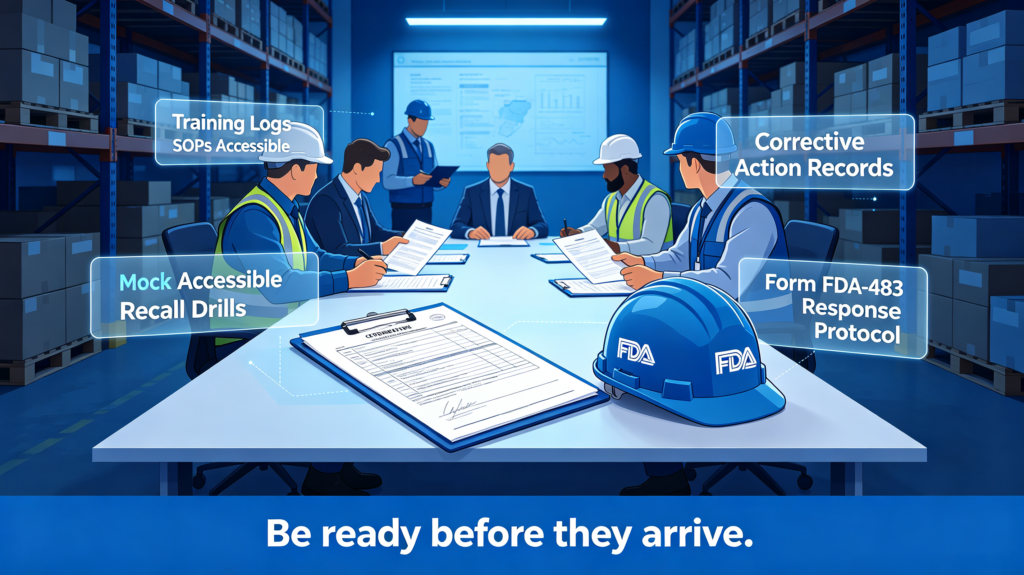
For Aur, Jetson maintains inspection-ready documentation at every facility—from training logs and sanitation records to traceability reports and mock recall results. When an FDA investigator arrives, the documentation is already organized, current, and accessible.
Becoming an FDA Approved Warehouse? Jetson Has Solutions for You
Becoming an FDA-compliant warehouse in 2026 is not a one-time certification. It is an ongoing operational discipline that touches registration, facility design, FSMA preventive controls, documentation, and staff training. For brands like Aur that store regulated products, partnering with a warehouse that treats compliance as a core capability—not a checkbox—is the difference between a supply chain that moves and one that gets held.
For brands like Aur, success in regulated fulfillment requires the right partner to handle the compliance complexity. Jetson provides end-to-end FDA-compliant warehousing designed specifically for regulated products—from facility registration and temperature-controlled storage to FSMA preventive controls, lot-level traceability, and inspection-ready documentation. With Jetson, Aur can focus on growing the business while we ensure every product stays compliant, every lot stays traceable, and every inspection stays clean.
Choose Jetson to transform your regulated fulfillment operation from a compliance burden into a competitive advantage. Contact us today to learn how we can help you store, ship, and scale FDA-regulated products with confidence.