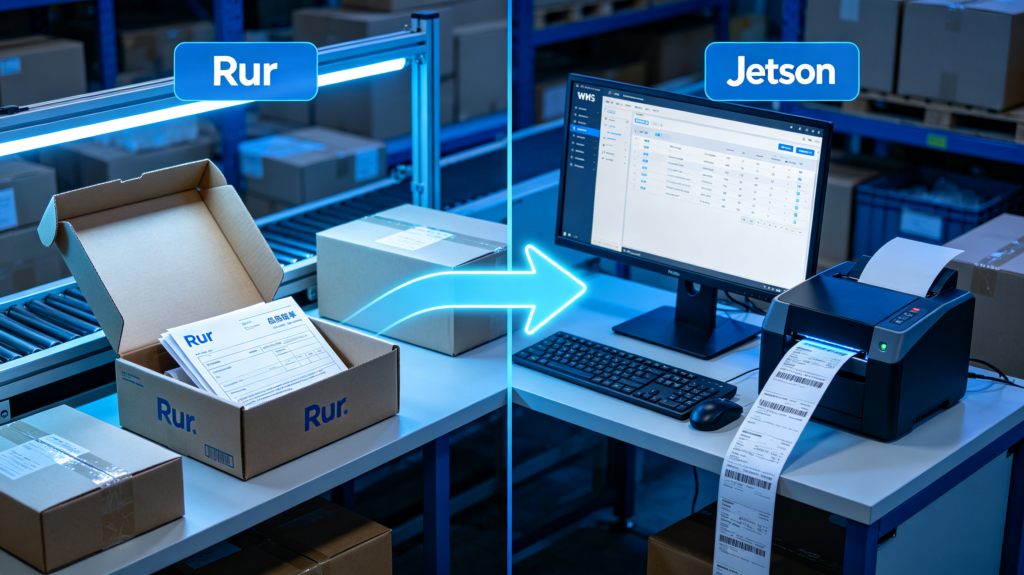
A packing slip is one of the least glamorous documents in ecommerce—and one of the most underestimated. It is not a marketing brochure. It is not an invoice. It is the single document that connects your warehouse team, your fulfillment partner, and your customer in a shared understanding of what is inside the box. Yet many ecommerce brands still treat it as an afterthought, printing generic templates that do nothing to reduce errors, speed up returns, or reinforce their brand.
For brands like Rur, a growing ecommerce business, the packing slip is not just a piece of paper. It is a control layer. It is a quality check for the warehouse. It is a trust signal for the customer. And when it is automated and integrated with your fulfillment system, it becomes a cost-saving tool that reduces mis-shipments, accelerates processing, and eliminates manual data entry. This guide walks through exactly what a packing slip should contain, how it differs from other shipping documents, and how to automate it for maximum efficiency. And as always, Jetson is here to help brands like Rur turn packing slips from a manual chore into a seamless part of fulfillment—by providing automated document generation, real-time order data integration, and branded slip customization that keeps operations running and customers informed.
Step 1 : Understand What a Packing Slip Actually Is
Before optimizing a packing slip, you need to understand its precise function. A packing slip is a non-financial document included inside a shipment that lists the items contained in the package. It confirms what the customer ordered and what was actually packed—nothing more, nothing less. It does not show pricing, payment method, or billing information. That distinction is critical, and it is where most brands get confused.
Packing Slip vs Invoice
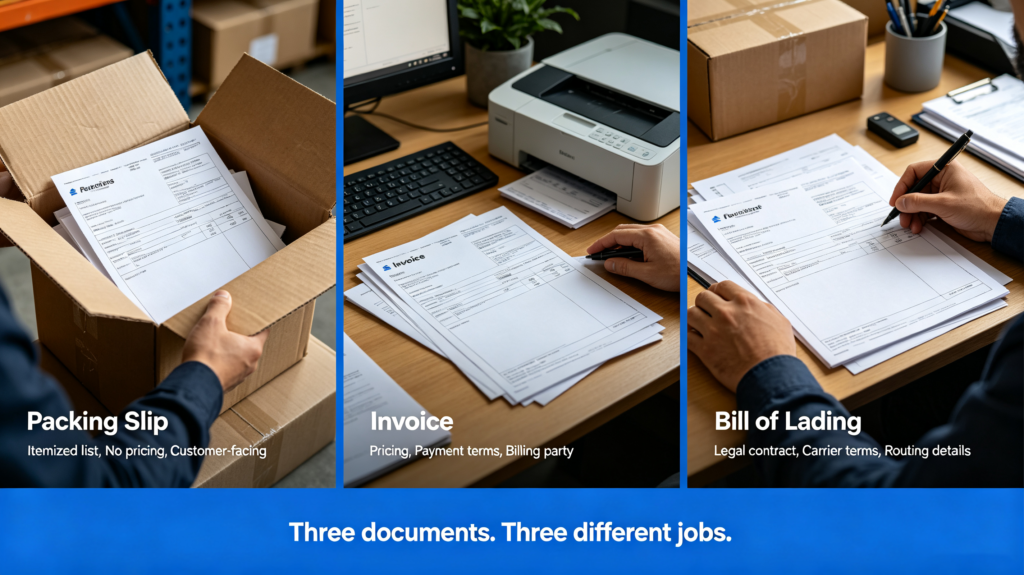
A packing slip and an invoice serve different purposes for different people. A packing slip denotes the physical goods being received, while an invoice is the financial document of the order. The invoice contains pricing, payment terms, and the total amount due. The packing slip does not. In some cases, they are intended for different recipients: the invoice goes to the person responsible for payment, while the packing slip goes to the person who receives the package.
Key implication : If you are shipping a gift directly to a recipient, never include pricing information in the box. The packing slip protects both the sender’s privacy and the recipient’s experience.
Packing Slip vs Bill of Lading
A bill of lading is a legally binding contract between the shipper and the carrier, confirming that goods have been received for transport. It contains routing details, freight class, weight, and carrier terms. A packing slip, by contrast, stays inside the box and is not a legal transport document. While the bill of lading stays between the carrier and shipper, the packing slip is provided to the customer.
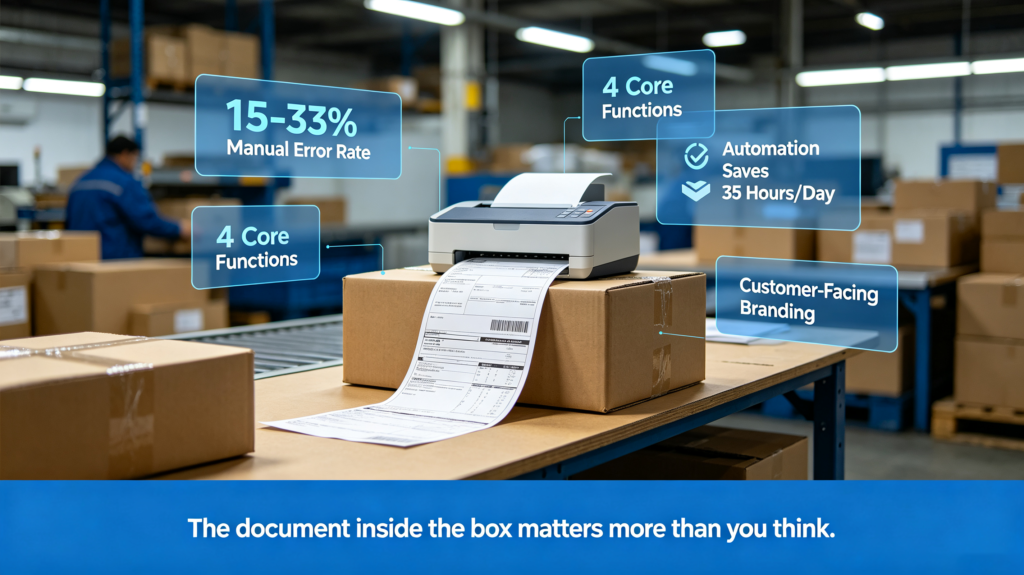
Four Core Functions
A packing slip serves four distinct functions across the order journey:
- During fulfillment : Warehouse staff use it as a checklist to confirm every item on the order has been included in the box.
- During transit : Customs officers may use it to verify the contents of a cross-border shipment.
- After delivery : The customer uses it to check their order against what they actually received, and to initiate a return if needed.
- For customer service : The order number on the slip gives support teams a reference to look up an order when a customer calls with a question.
Step 2 : Include Every Element That Reduces Errors and Confusion
A packing slip that omits critical details creates ambiguity for warehouse staff and frustration for customers. The goal is not to make the document longer—it is to make it unambiguous. For brands like Rur, every element on the slip should serve a purpose: reducing the chance of a packing error, speeding up a return, or answering a customer question before it is asked.
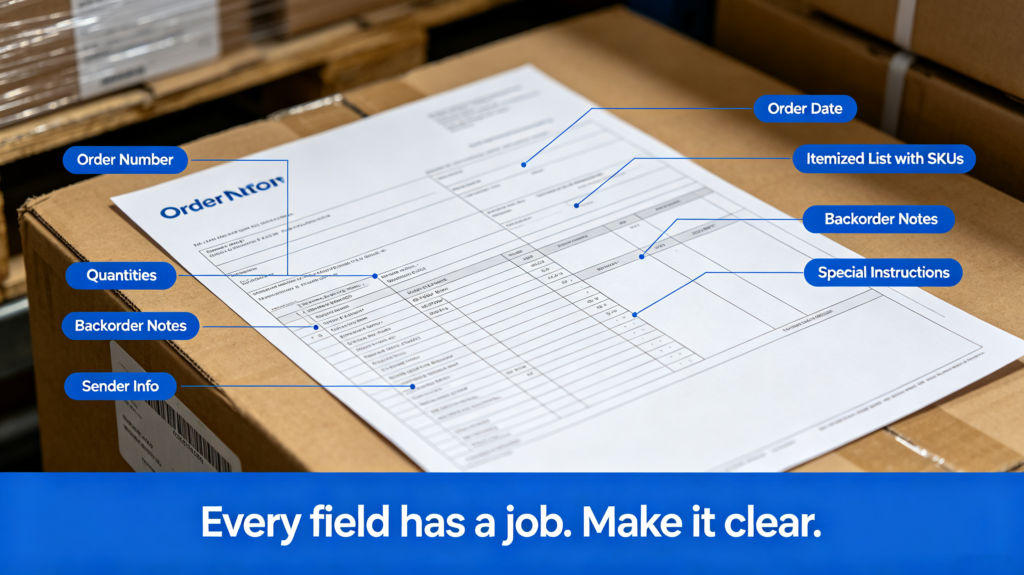
Order Identification Details
Every packing slip should carry a unique order number and order date. The order number connects the physical shipment back to the original order in your system, making it easy for customer service teams to look up an order and giving the customer a reference number for follow-up. The order date helps both parties track timelines and confirm that the shipment meets any time-sensitive requirements.
Pro Tip : Include the slip or PO number as well. This references a specific purchase order or shipping slip associated with the transaction, linking the shipment to internal records for efficient cross-referencing.
Itemized Product List with SKUs
Every product included in the shipment should be listed by name and quantity. This gives warehouse staff a checklist to follow while packing and gives the customer a way to confirm that what they received matches what they ordered. Placing SKU numbers prominently next to each item—not buried in a separate column—makes the document more useful for packers who need to verify items quickly.
Worked example:
| Line | SKU | Product | Qty |
|---|---|---|---|
| 1 | RUR-TSH-BLK-M | Essential Tee – Black – Medium | 2 |
| 2 | RUR-HOD-GRY-L | Comfort Hoodie – Grey – Large | 1 |
| 3 | RUR-SCK-WHT-OS | Logo Socks – White – One Size | 3 |
Pro Tip : Include weight and dimensions on the packing slip as well. These details help shipping departments determine what inventory needs to be sent out and support accurate carrier routing.
Backordered and Special Handling Notes
If an item is backordered, list it explicitly on the packing slip so the customer knows it is coming separately and does not assume it was forgotten. If an order requires gift wrapping, fragile handling, or specific delivery instructions, dedicate a space for these notes so whoever is packing or delivering the order sees them instantly.
Key implication : Unlisted backorders are one of the most common drivers of “missing item” support tickets. A single line on the packing slip prevents the inquiry entirely.
Sender and Receiver Information
The packing slip should clearly state who sent the package and who should receive it. This includes the company name, return address, and the recipient’s shipping address. The warehouse and carrier rely on this information to route the package correctly. Never include sensitive payment details in this section—the packing slip is not the place for financial data.
Step 3 : Automate Packing Slip Generation to Eliminate Manual Errors
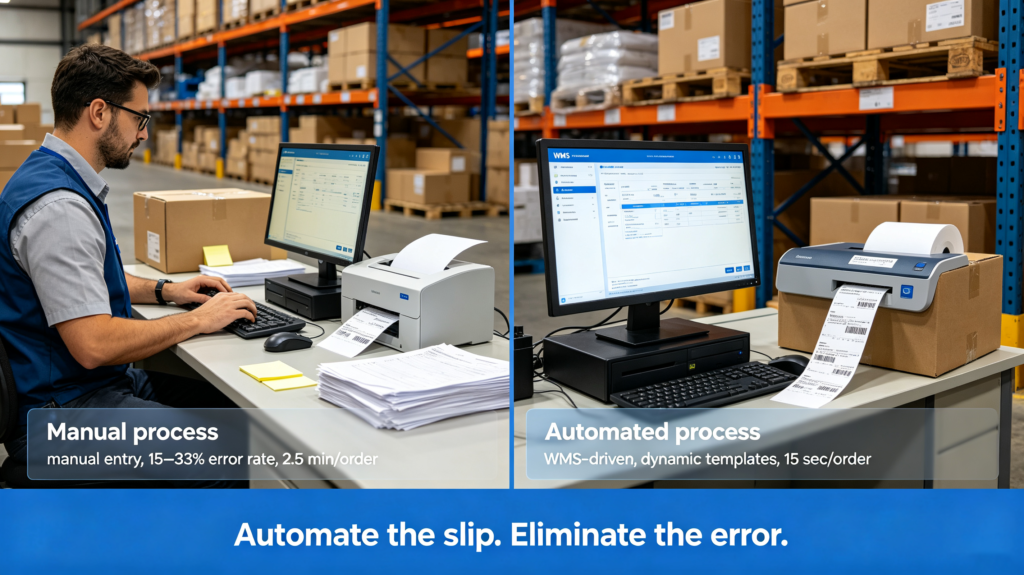
Manual packing slip generation is a hidden source of fulfillment errors and wasted labor. Industry research puts manual receiving accuracy between 67% and 85%, meaning 15 to 33 of every 100 packing slips carry a data error at typical manual accuracy. One miscounted quantity cascades into a pick short, a delayed shipment, and an unhappy customer. For brands like Rur, automating packing slip generation is not a convenience—it is a risk-reduction measure.
WMS-Driven Slip Generation
A warehouse management system should decide what prints on a packing slip, not each sales channel separately. When the WMS generates packing slips automatically from live order data, the slip reflects exactly what the system expects to be in the box: order ID, SKU, bin, quantity, and exception status all visible before sealing. This eliminates the gap between “what the system thinks” and “what the slip says.”
Advantages : Eliminates manual data entry, ensures slip-to-order accuracy, captures bin and exception data.
Challenges : Requires WMS integration and standardized slip templates across channels.
Combined Printing for Speed
One of the highest-impact automation wins is combining the shipping label and packing slip into a single printout. DTK, a logistics operator, cut processing time from two and a half minutes per order to just 15 seconds by combining these documents, saving 35 printing hours per day and significantly reducing plastic use, stress, and costs across its logistics network.
Worked example : At 500 orders per day, a 2-minute reduction per order saves over 16 hours of labor per day. At 1,000 orders per day, that figure doubles. The savings compound across every fulfillment center.
AI-Generated Templates and Dynamic Content
Modern packing slip systems support template generation using natural language prompts or HTML, with placeholders that dynamically populate during label generation. This means a single template can adapt to different order types, product categories, and customer segments—populating the correct SKU, quantity, and special instructions without manual intervention. AI-generated packing slips can also flag exceptions before the box is sealed, catching discrepancies while they can still be corrected.
Step 4 : Turn the Packing Slip into a Brand Touchpoint
A packing slip is often the first physical document your customer sees after checkout. It is the bridge between the digital transaction and the physical delivery. When it is generic and unbranded, it is wasted space. When it is thoughtfully designed, it reinforces your brand, guides the customer through the unboxing experience, and reduces the friction of returns. For brands like Rur, every touchpoint in the box is a chance to build loyalty.
Consistent Branding Elements
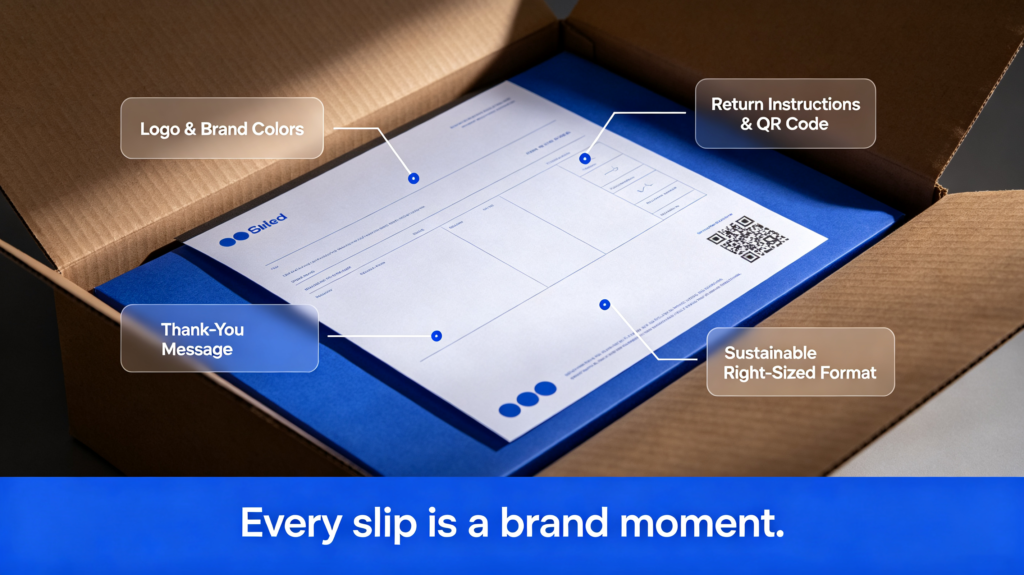
Branded packing slips contain the logo, colors, and typography of the brand, and are particularly useful in ecommerce shipments because they tie the digital world where the order took place to the physical delivery of the items. When a customer opens the box and sees a document that matches the visual identity of the website they ordered from, the experience feels intentional rather than transactional.
Key implication : A branded packing slip is free real estate. It costs nothing extra to print a logo at the top of the page, but it changes how the customer perceives the entire order.
A Thank-You Message and Return Instructions
A personalized thank-you message on the packing slip signals that the order was packed by a brand that cares. Equally important is clear return instructions. When a customer knows exactly how to initiate a return—what to do, where to send it, and what to expect—the return process becomes less adversarial and more collaborative. Listing a dedicated return line on the packing slip adds a functional element that supports the returns workflow.
Pro Tip : Include a QR code on the packing slip that links directly to your self-service returns portal. This reduces inbound support inquiries and accelerates the return initiation process.
Sustainable and Right-Sized Design
Packing slips are inherently paper-based, but they do not need to be wasteful. Right-sizing the slip to the smallest readable format, printing double-sided where appropriate, and using recycled paper are simple steps that align with customer sustainability expectations. Some fulfillment operations now combine the packing slip with the shipping label on a single page, eliminating an entire sheet of paper per order. These small design choices reduce material costs and reinforce a brand’s commitment to responsible operations.
For Rur, Jetson provides branded packing slip solutions—including logo and brand color integration, dynamic thank-you messages, return instruction fields, and QR code generation for self-service returns. Every slip is generated automatically from live order data, ensuring accuracy without manual intervention.
Optimizing Packing Slips? Jetson Has Solutions for You
Optimizing packing slips is one of the lowest-cost, highest-impact improvements an ecommerce brand can make. By understanding what a packing slip is, including every element that reduces errors, automating generation to eliminate manual data entry, and turning the slip into a brand touchpoint, brands like Rur can reduce fulfillment errors, speed up processing, and strengthen customer loyalty—all from a single document.
For brands like Rur, success in fulfillment documentation requires the right partner to handle the operational complexity. Jetson provides end-to-end fulfillment solutions designed specifically for document accuracy and brand consistency—from WMS-integrated packing slip generation and combined label-slip printing to branded template customization and QR-code-enabled return workflows. With Jetson, Rur can focus on growing the business while we ensure every box that leaves the warehouse carries the right document, with the right information, every time.
Choose Jetson to transform your packing slip from a manual chore into a fulfillment advantage. Contact us today to learn how we can help you automate, brand, and optimize your packing slips with confidence.